Wednesday, February 8, 2012

Facebook: Is this any place for the not-so-self-assured to make friends?

From the Los Angeles Times:


Facebook, the social networking giant that connects 845 million people to one another, may be a jolly gabfest for the self-assured. But for those who suffer from low self-esteem, it appears to be a rather nasty trap, luring such people into self-disclosures that prompt many a Facebook friend to agree with their low opinion of themselves.


A new study, set to be published in the journal Psychological Science, explored the dynamics of friendship on Facebook to see what benefits or pitfalls the site might offer to a population that could use the propping up of a few new friends: those who think poorly of themselves, fear judgment by others and are prone to social isolation and depression.


Enlisting a slew of undergraduates for three separate studies, they found that those with low self-esteem are encouraged and emboldened by Facebook's capacity to provide a forum for social interaction that doesn't risk awkward face-to-face communication. They established that, given the opportunity for such social interaction, those with low-esteem do engage in the kind of self-disclosure that is thought essential for friendships to take hold and deepen.


The information contained in this blog can not be considered medical advice. These are only my own thoughts, feelings & ideas. If you or someone you know are having problems with mental illness please seek qualified medical advice.

Traumatic experience, silence linked

London, Feb 5 (IANS) People who suffer a traumatic experience often don't talk about it, and many forget it over time.
"There's this idea, with silence, that if we don't talk about something, it starts fading," says Charles B. Stone of Belgium's Universite Catholique de Louvain, the co-author of a study on the subject.
But that belief isn't necessarily backed up by psychological research-a lot of it comes from a Freudian belief that everyone has deep-seated issues we're repressing and ought to talk about, the journal Perspectives on Psychological Science reports.
The real relationship between silence and memory is much more complicated, Stone says, according to a university statement.
"We are trying to understand how people remember the past in a very basic way," Stone says. He co-authored the study with Alin Coman, Adam D. Brown, Jonathan Koppel of the universities of Pittsburgh, New York and Aarhus (Denmark) and William Hirst of the New School for Social Research.
The information contained in this blog can not be considered medical advice. These are only my own thoughts, feelings & ideas. If you or someone you know are having problems with mental illness please seek qualified medical advice.

Mind Over Matter

Patients’ Perceptions of Illness Make a Difference

A recent press release by the Association of Psychological Science has suggested that what the sufferer thinks of their illness (ANY illness)  plays a large roll in determining their health outcomes. Research of existing literature on patients' perception of illness by Keith Petrie (University of Aukland) & John Weinman (Institute of Psychiatry at Kings College) indicates that a persons perception of their illness has a direct relationship to several key health outcomes.

These key outcomes include their level of functioning and ability, utilization of health care, adherence to treatment plans laid out by health care professionals, and even overall mortality. Further  research suggests that how a person views their illness may play a bigger role in determining  their health outcomes than the actual severity of  their disease.

Read the full press release on the Association of Psychological Science website.

The information contained in this blog can not be considered medical advice. These are only my own thoughts, feelings & ideas. If you or someone you know are having problems with mental illness please seek qualified medical advice.
Tuesday, February 7, 2012

Fight Stigma

Stamping Out the Stigma of Mental Illness

It is an undisputed fact that individuals who experience mental health issues are often faced with discrimination that results from misconceptions of their illness. As a result, many people who would benefit from mental health services often do not seek treatment for fear that they will be viewed in a negative way. The World Health Organization agrees and says that in the 400 million people worldwide who are affected by mental illness, about twenty percent reach out for treatment . The World Psychiatry Association began an international program to fight the stigma and discrimination many people hold toward individuals who have mental health issues.
It is the 21st century, and though evidence-based research has shown us that mental illness is a real medical disorder, stigma is on the rise instead of on the decline. David Satcher, US Attorney General writes, “Stigma was expected to abate with increased knowledge of mental illness, but just the opposite occurred: stigma in some ways intensified over the past 40 years even though understanding improved. Knowledge of mental illness appears by itself insufficient to dispel stigma.”

Mental illness: myth versus fact

Here are some common myths that may be used to justify negative feelings about people with mental illness:
MYTH:
Mental illness is fairly rare and doesn't affect average people.
FACT:
Mental illness is quite common. According to the American Psychiatric Association, one in five Americans suffer from a mental disorder in any given year. Mental illness can strike people of any age, race, religion or income status.
MYTH:
People with mental illnesses are dangerous.
FACT:
This powerful myth has been fed by the media. In fact, the vast majority of people with mental illnesses are not dangerous. They are much more likely to be the victims of violence and crime than the perpetrators.
MYTH:
If you have a mental illness, you can will it away. Being treated for a psychiatric disorder means an individual has in some way "failed" or is weak.
FACT:
A serious mental illness cannot be willed away. Ignoring the problem does not make it go away, either. It takes courage to seek professional help.
MYTH:
Depression and other illnesses, such as anxiety disorders, do not affect children or adolescents. Any problems they have are just a part of growing up.
FACT:
Children and adolescents can develop mental illnesses. One in ten children or adolescents has a disorder severe enough to cause impairment.
MYTH:
Most people with a mental illness are receiving treatment.
FACT:
Only 1 in 5 persons affected with a mental illness seeks treatment.
MYTH:
Mental illness is more like a weakness than a real illness.
FACT:
Mental illnesses are as real as other diseases like diabetes or cancer. Some mental illnesses are inherited, just as some physical illnesses are. They are not the result of a weak will or a character flaw.
MYTH:
People with mental illnesses can never be normal.
FACT:
Science has made great strides in the treatment of mental illness in recent decades. With proper treatment, many people with mental illnesses live normal, productive lives.
How you can fight stigma
We can all do our part to reduce stigma and make life easier for the millions of people who struggle with mental illness. Here are some ideas:
  1. Educate yourself about mental illness. Having the facts can help you challenge the misinformation that leads to stigma.
  2. Be aware of words. Don't reduce people to a diagnosis. Instead of "a schizophrenic," say "a person with schizophrenia." Correct people who use hurtful language to describe people with mental illness, such as "psycho" or "crazy."
  3. Challenge media stereotypes. Write letters to any newspapers, TV or radio stations that promote negative portrayals of people with mental illness.
  4. Support those with mental health issues. Treat them with respect. Help them find jobs or housing. Encourage them to get or stick with treatment.
  5. Share your story. If you or someone in your family has had a mental illness, speak up about it. Your example could help someone else.
"Mental illness is nothing to be ashamed of, but stigma and bias shame us all."
Bill Clinton

The information contained in this blog can not be considered medical advice. These are only my own thoughts, feelings & ideas. If you or someone you know are having problems with mental illness please seek qualified medical advice.

Is There Anybody Out There?

I came across this song on YouTube, Is There Anybody Out There? by Secondhand Serenade. It just seemed to click with me, describing how I've felt at times when in a deep depression. You just seem to wonder - is there anybody out there?


A bit of a 'down' sort of song, but one I'm sure to listen too in my blue times.

Cheers

The information contained in this blog can not be considered medical advice. These are only my own thoughts, feelings & ideas. If you or someone you know are having problems with mental illness please seek qualified medical advice.

Monday, February 6, 2012

Excessive gamers more depressed?

Victoria University recently published a report from preliminary studies that seem to show that gamers who average 33 hours a week or more playing may have higher levels of anxiety & depression than those who play less frequently.
Excessive video gamers may have higher levels of anxiety and depression, according to preliminary studies at Victoria University.
Video gaming researcher Daniel Loton is conducting a global study comparing academic results, relationships and physical and mental health in excessive gamers – who spent on average more than 33 hours a week playing video games – with more balanced players who devoted 21 hours to the pursuit. 
Preliminary results show the excessive gamers reporting15 per cent more stress and anxiety and 25 per cent more depression than balanced gamers.
“Both groups averaged levels of stress, anxiety and depression well above norms reported in past studies,” Mr Loton said. “But most alarming was that excessive gamers scored more than half the maximum measure for each and enough to determine clinical significance.”
He said excessive gamers also showed different coping styles than balanced gamers.

The information contained in this blog can not be considered medical advice. These are only my own thoughts, feelings & ideas. If you or someone you know are having problems with mental illness please seek qualified medical advice.

Vitamin D to fight depression?

Low levels of vitamin D have been linked to depression, according to UT Southwestern Medical Center psychiatrists working with the Cooper Center Longitudinal Study. It is believed to be the largest such investigation ever undertaken.

Low levels of vitamin D already are associated with a cavalcade of health woes from cardiovascular diseases to neurological ailments. This new study – published in Mayo Clinic Proceedings – helps clarify a debate that erupted after smaller studies produced conflicting results about the relationship between vitamin D and depression. Major depressive disorder affects nearly one in 10 adults in the U.S.

Dr. E. Sherwood Brown and MinhTu T. Hoang
Dr. E. Sherwood Brown and MinhTu T. Hoang
“Our findings suggest that screening for vitamin D levels in depressed patients – and perhaps screening for depression in people with low vitamin D levels – might be useful,” said Dr. E. Sherwood Brown, professor of psychiatry and senior author of the study, done in conjunction with The Cooper Institute in Dallas. “But we don’t have enough information yet to recommend going out and taking supplements.”
Read the full article on the UT Southwestern Medical Center website.

The information contained in this blog can not be considered medical advice. These are only my own thoughts, feelings & ideas. If you or someone you know are having problems with mental illness please seek qualified medical advice.

Depression is an illness, not a life choice

Kim Lester from ABC Australia recently posted a story on The Drum about her own experiences with depression & suicidal thoughts. As I discussed in an earlier post, she found talking to someone about her problems helped a lot.

"On the few occasions that suicide is reported in the media - generally if the victim is famous or the act was committed in a particularly gruesome manner - there is one reaction that makes me want to scream.
"What a stupid thing to do."
Sure suicide is stupid, depression is stupid, and the public's understanding of mental illness is especially stupid. But a victim of suicide wasn't stupid, they just lost the battle.
No-one with a terminal illness would be called stupid for giving up the fight. For them it's a tough fight. They were brave to push on as long as they did. But depression is a private illness, the symptoms are mostly internal and many people don't like - or know how - to articulate it, so it's no wonder they don't understand why someone would take their own life.
I don't claim to know what goes through the mind of every person with a mental illness. I can only speak from my own experience, but that experience has given me an insight into why depression, if left untreated, can be fatal."

The information contained in this blog can not be considered medical advice. These are only my own thoughts, feelings & ideas. If you or someone you know are having problems with mental illness please seek qualified medical advice.

Thursday, February 2, 2012

Ex-Wallaby Clyde Rathbone Battles The Black Dog

On Tuesday (31/01/2012), 30 year old Clyde Rathbone, a former international rugby union star for the Australian Wallabies (15 tests between 2004 & 2006) made a startling post on his Facebook wall revealing his personal battle with mental illness.

In the post, Rathbone speaks openly about his past & how emotional abuse as a child left him battling mental illness throughout his life. He asked that his story be distributed in an attempt to help others deal with similar situations.

It is with thanks to people like Clyde that the issue of mental illness is being brought out into the open. His candid story can only help in raising awareness of mental health issues & the stigma associated with these illnesses. I would personally like to thank him for this frank & deeply personal post & wish him all the best for the future as he continues to face his problems.

Here is his story, in his own words:
“Sometimes we have to take risks, be terrified and do it anyway. Julian Smith wrote this: http://inoveryourhead.net/100-tips-about-life/ so I decided to contact him, below is what I wrote. Just like I’ve asked Julian I’m asking you all to send this to somebody you know if you think it might help them.
I’m not really sure where to start, if this appears as unlettered and rambling as I fear please accept my apologies …
I first heard about you whilst listening to Robb Wolfs podcast, from there I found your blog, read every single post, downloaded & read “Flinch” which resonated with me in ways I’m not nearly well enough equipped to articulate so I’m forced to drag out the cliché that it changed my life, but fuck it it did!
I know my story is neither as boring or as interesting as I think it is, I hope you’ll bare with me and read it (there’s an idea at the end, and I know you like those) but if you decide not to I’m fine with that too.
I was born in South Africa 30 years ago I’m the oldest of 4 boys, I had a difficult childhood, I was abused emotionally by someone who should have been looking after me. And it had a huge effect on me. A number of things can happen when you’ve been emotionally abused. Every negative thing I heard about myself, things that were said repeatedly to me became my truth, I started to believe that negative voice until it became ingrained, it affected me in nearly everything that I did and every decision I made. Usually people who are exposed to this abuse have extremely low confidence and low self esteem, In my case that was certainly true but those that knew me in high school may well describe me as arrogant, my defence mechanism was to project an image of myself that most protected me.
I was lucky in a sense because the abuse I suffered was inconsistent and definitely not as bad as many others are exposed to. So I ended up a confused, conflicted & pretty angry child and I know what saved me was that I was always good at sports, I was good at just about any sport I tried and gradually over time I started to challenge some of these negative thoughts that I had by performing well in sport. Ironically I used those negative thoughts as a driving force, as if every time I achieved success it was a reaffirmation to myself that those negative thoughts weren’t true. Every time I trained hard or played well I felt I was winning the battle against those thoughts.
And I did this most of my childhood and adulthood, this unlikely process turned me into a world class athlete, I captained the South African National U21 team to victory in the 2002 Rugby World Cup. Shortly after that I was offered a contract to play for the Brumbies rugby team in Australia. And since I knew my family planned to immigrate to Australia soon I decided to take up the offer. It was not long before I was playing for the Australian National Team, travelling the world and basically living what I thought were my dreams. The thing is I was never happy, I felt guilty that I could not appreciate the life many others could only dream of. By this point I had convinced myself that what I had gone through as a child was not that bad and I basically tried to forget about it. The fact is those issues never left me completely, they would express themselves in many ways. I would be angry or irritable or feel tension and stress and not really know why but for the most part I would say I functioned as well as I could and anyone who met me would think I was completely “normal”. And I maintained that fictitious existence for years.
But this all began to gradually change about 5-6 years ago when I picked up some serious rugby injuries which ultimately forced me to retire @ 27. That was a catalyst for a flood of all those negative thoughts I had pushed to the background, many I had not had for years slowly began coming back and over time I slipped further and further into depression until I was chronically and severely depressed.
Though my body was broken I agreed to play some minor level club rugby, I injured myself in a match and needed surgery to insert a titanium plate in my face. I was on a lot of painkillers and I would go days when I would hardly get out of bed. I felt despairingly low all day, I had no motivation or optimism, I began having suicidal thoughts. And I want to say this about depression, I always looked at it as something that happened to “other people”, until I become depressed it never even crossed my mind that it could happen to me. What I’ve learnt over time is that any of us can become depressed given the wrong mix of experiences.
In that state, in the deepest of my depression my marriage began failing, I become short tempered and verbally abusive to my wife, there was never physical abuse but there is no doubt she suffered hugely emotionally. I completely neglected her and her needs. I did not know how to climb out of the hole I felt I was in, I did not even know where to start. Finally in Late 2010 I told my wife what I had gone through as a child, 10 years after our relationship began and 5 years into our marriage she was learning this for the first time.
And while it felt initially better to finally tell someone what happened, in some ways it made things worse because I began to see how much of my life had been affected by what happened to me as a child and it brought a lot of anger and resentment to the surface.
By mid May of last year my wife had had enough, she came to the conclusion that she could not help me. She had tried everything she knew to try and nothing seemed to change. She packed a bag and left to stay with her friend. Going through depression is difficult enough, but since I’ve recovered I’ve begun to realise just how tough it must have been for my wife to observe the person you care about most struggling for as long as I did while nothing my wife tried seemed to work. I think often we forget about the toll that depression takes on the people who are caught trying to help those suffering from it. If there is a hero in this story it’s how my wife has managed to remain as strong as she did for as long as she did.
Carrie leaving devastated me, that’s is both the most difficult and most valuable thing I’ve been through, because it was the first time I felt as though I was going to lose the most important thing in my life. It focussed my mind for the first time in a long time. I was at a crossroads, either I do whatever I must to completely rid myself of depression or it was likely going to cost me my marriage and probably ultimately kill me.
So as Carrie had been bugging me to do for ages I went to see a psychologist, I went to 5 sessions and they were incredibly valuable in helping me focus on the things I have control over and challenging the way I was thinking about things.
After I started getting some help the main thing I developed was consistency. I started working out again, dialling in my diet, working and reading like I was starving for knowledge and I began seeing old friends again.
For the last 6 months I’ve been completely free of any sort of depression, I experience the general ups and downs of life and every now and again you get a curve ball thrown your way but at no point have I ever felt as though I’m becoming depressed or that I’m slipping back into old habits. I think of my mind in the same way I think about a broken bone that heals stronger than it was before. I feel indestructible, I rarely flinch and when I do I make sure forge ahead anyway.
Today I will finally share this story with my brothers and parents, that will be both painful and cathartic. On the 10th Feb I’ll be sharing this with a few hundred people at a speaking engagement I’m doing through work (I own a corporate health business: www.healthfutures.com.au) I feel as though by talking about it at least some good can come from a bad experience, that maybe some of the people I talk too are struggling or know someone that is and perhaps hearing my story might help them to take come action.
All of this brings me to my wife. Carrie is far and away the best thing that ever happened to me, she’s the most kind, gentle, generous, smart, funny, beautiful soul. She sees the world differently to most of us. No matter how dark a situation seems her strength of character and spirit see her through. Her strength ultimately wore her down, when I was ill she told nobody, she took every single burden of my depression squarely on her shoulders and she did everything she could. By the time she left she was literally done, I had been emotionally shut down for years and I had worn her down to the point where she had to choose between becoming depressed herself or staying in an abusive situation. She did the right thing in leaving.
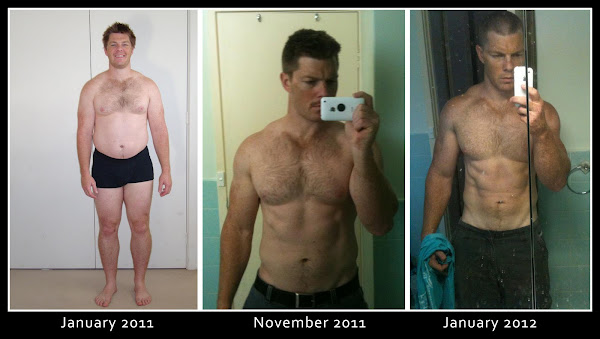
Since then I’ve made incredible progress, I don’t recognise myself. I’ll send you a picture taken in Jan 2011 and another taken a little while ago in November. Transforming my mind has allowed me to transform my body. I’ve never in my life felt as capable of anything I decide to do as I feel today. I seek out things that scare me and I attack them. I feel things deeper than I ever have and my mind is always searching for that next morsel that might just change the way I view the world. Julian, I feel lucky to have found your blog, to have learned who Robb Wolf is and to have been exposed to Mark Sisson’s work. I feel enormously enlightened and humbled by the works of Sam Harris, Christopher Hitchens and Richard Dawkins. The internet is fucking amazing, I guess I just feel lucky.
And I need your help. I need this story broadcast, I need everyone I know and everyone I don’t to read this. I need that for me but mostly I just need to tell my wife that I love her and that I’m sorry, and that anything she chooses to do for her happiness is the right decision. I need her to know that she should never settle for happier than she’s been in 10 years when what she deserves is happier than she ever imagined you could be.
So what I’m asking is that you post this on your blog, send it to anyone you can, comment on it or don’t. I just need it out there…
Thank you,
Clyde Rathbone”
I hope Clyde's story encourages others to face the problems associated with mental illness.


The information contained in this blog can not be considered medical advice. These are only my own thoughts, feelings & ideas. If you or someone you know are having problems with mental illness please seek qualified medical advice.

Who You Are Makes A Difference

Added a new page to the blog: Who YOU Are Makes A Difference: Blue Ribbon

I'm passing my blue ribbon on to everyone who visits - check it out!

Cheers

The information contained in this blog can not be considered medical advice. These are only my own thoughts, feelings & ideas. If you or someone you know are having problems with mental illness please seek qualified medical advice.

Wednesday, February 1, 2012

New Hope For Depression

Another sleepless night for me but making good use of it. I don't watch much television at all, news & current affairs programs in particular. I just find them generally too depressing so half the time I don't know really what's going on in the outside world - not always a bad thing I think.

Was chatting on the phone with a friend earlier and they mentioned a report on a local current affairs program Today Tonight about a medical procedure now being used to treat deep depression here in Australia. It appears a treatment for Tourette syndrome & Parkinsons disease is proving successful in treating deep depression.

The procedure involves inserting 2 electrodes into the brain connected to a pace-maker type battery to stimulate the brain. The operation takes about 6 hours & you remain awake through-out it. Now that sounds fun. It appears the operation is available in all states except NSW where it has been banned.

The procedure is performed by Precision Neurosurgery.


The information contained in this blog can not be considered medical advice. These are only my own thoughts, feelings & ideas. If you or someone you know are having problems with mental illness please seek qualified medical advice.

Monday, January 30, 2012

Local Mental Health Services - A Rant

<==RANT MODE ON==>

Well it's 2:30am here & again I can't sleep, so my mind has been wandering. One thing that has been on my mind lately is the quality of the mental health services where I now live in regional NSW. Truthfully, I'm not happy with it at all.

I lived in Sydney for about 30 years prior to moving back to the area where I was born. With my mental health problems I just couldn't handle the city life any more - I had to get somewhere that had a more relaxed lifestyle. I'm not living in the sticks, this town has a population of around 35,000 but that's a lot less than the millions in Sydney, which is about 2 hours away.

Up there I was used to dealing with pretty well organised mental health services - many hospitals have 24hr mental health staff & mental health wards. It wasn't THAT hard to find help when it was needed, at any hour of the day. But here it is so different.

I have met a number of mental health workers down here & all seem to be good, professional people, though it appears overworked. But it seems at times the system here fails those in need, quite badly at times. If you are in need of help after hours, good luck finding it locally. The nearest 24hr services are about an hour away, where the staff are expected to cover the needs of several large hospitals.

You would think that a town this size would have better. It seems the regular treatment in the hospital is to wait for the person to calm down a little then send them home with promises of a follow-up from the local Community Mental Health Services - which seems to get lost somewhere, as often the calls don't eventuate. A town this size deserves better - the people deserve better.

An example of this breakdown in services happened to a friend of mine a couple of weeks ago. Mentally, he was in a terrible state. He'd been cutting himself & another friend went to help him but needed to call the police. After the police arrived he pulled a knife on them. They were ready to tazer him. The end result was an ambulance was called & he was taken to the hospital.

The last thing I expected was for him to be released a couple of hours later with nothing more than a promise of a couple of follow up calls, one for an appointment with a local service & the other to be from community health. Well he DID get the one about the appointment but as far as I know he's still waiting for the other call.

The hospital simply doesn't have the facilities to deal with these types of situations. Being the only major hospital for an hour in any direction you would think that it could provide something better. Sadly it doesn't, and this isn't an isolated incident that I've seen, it's been happening to another friend for months.

Mental health is a major problem and needs more support from governments. If a town this size can't provide appropriate around-the-clock services, what hope do sufferers have who live in more isolated areas.

<==RANT MODE OFF==>

Feels good to have that off my chest. :)

The information contained in this blog can not be considered medical advice. These are only my own thoughts, feelings & ideas. If you or someone you know are having problems with mental illness please seek qualified medical advice.

Sunday, January 29, 2012

SANE UK: Blue Mood Month

As part of its 25th anniversary, SANE UK has launched it's Black Dog Campaign to raise awareness of mental health issues during its Year of the Black Dog. To kick it off they announced Blue Mood Month where celebrities such as Stephen Fry were asked to contribute playlists 'of their favourite sad songs that make you happy'.

Sounds like a bit of a contradiction, sad songs making you happy, but I understand what they mean, at least to me anyway. When I get depressed I attach a lot of emotion to music and a good sad song can get me crying. But this is a release of emotional tension & stress for me and the end result is I can feel better after letting it out. And many songs can make you feel you're not alone, there are others out there who feel like you do - it's not the end of the world, it can get better.

Now, I am far from a celebrity so I will never be asked to contribute a list & can't access Spotify to add my list to their public ones. So I'll list mine here, with links to YouTube. So these are my 'sad songs that make me happy' in no particular order:

You'll Never Walk Alone - Jerry & The Pacemakers
Everybody Hurts
 - R.E.M.
Nothing Compares 2 U - Sinead O'Connor
Don't Let The Sun Go Down On Me - George Michael & Elton John
Travelling Soldier - Dixie Chicks
Gravity - John Meyer
Key Largo - Bertie Higgins
True Colours - Cyndi Lauper
He Ain't Heavy - The Hollies
Hallelujah - Jeff Buckley
Lullaby - Nickelback
Time After Time - Cyndi Lauper
Yesterday - The Beatles
Tears In Heaven - Eric Clapton
The Living Years - Mike & The Mechanics

That will do for now - could list many more. Next time maybe I'll just do a list of 'good time songs' that can lift my emotions.

So what are your 'sad songs that make you happy'?


Cheers

The information contained in this blog can not be considered medical advice. These are only my own thoughts, feelings & ideas. If you or someone you know are having problems with mental illness please seek qualified medical advice.

Finding An Outlet

Over the years, when I've been right down in the pit of my depression, I find myself with a need to write. It's an urge that just happens - I get an idea in my head, maybe a line or two, that just won't go away until I put pen to paper (or fingers to keyboard). Sometimes it's just those couple of lines that I'll write and maybe come back later to expand on, to make it something that may be worth reading. But most times I can't stop until I have a finished product.

I have no real control over what I write & never know what to expect. A number of years ago I was going through a really bad period around Christmas. One night I sat down & wrote a poem that left no doubt what my state of mind was - The Storm is a dark way to describe my depression. Yet the next night, Christmas Eve, when I think I was feeling worse, the need to write struck again.

The end result this time was Christmas Is, a poem with a religious message about how the meaning of Xmas is being lost in the modern day. It is a poem of hope, faith and love that in no way reflected how I was feeling at the time. And I am far from a religious person, only going to churches for weddings & funerals. It just shows how little control I have when the mood hits - instead of some bleak, depressing, suicidal prose I got this.

Over the years I've found that this writing is a release for me, a way of getting tangled emotions & thoughts out. It's a personal therapy. Even this particular post is, it's coming out the same way as my other writings - just something I have to write at this very moment. This is my release for today.

Now I'm trying to get in the habit of writing even when I'm not depressed or waiting until the 'have to do it' feeling hits. I have found it a great outlet for everything that I would normally keep bottled up inside which would just leads to me feeling worse & worse if I didn't get it out. It is simply a way to help me deal with the situation. And I do think it does help.

Do you have an outlet to help you? If you haven't, maybe finding what works for you will help through the roughest parts of life. For me it's writing, but everyone is different so finding what works for you is trial & error. For me it was easy really, I just had the feeling that I HAVE TO DO THIS! It gets in my mind and becomes a compulsion, an obsession.

There is so much out there that can be used as your outlet. You could paint, draw, exercise, write or any number of things. Be creative in what you look at, it could be something that even you don't understand properly. If you get a feeling that there is something you just feel the need to do then give it a try, expand on it. Let it grow & feed it if you find it helps.

Have you found an outlet for your emotions? What do you do? Let me know, maybe your ideas & suggestions will help others by giving them ideas to work on. Your suggestions & thoughts could do more than you think - they may just save a life.

You can find more of my writings - my outlet on My Scribd Page.

Until next time......

The information contained in blog can not be considered medical advice. These are only my own thoughts, feelings & ideas. If you or someone you know are having problems with mental illness please seek qualified medical advice.

Saturday, January 28, 2012

A goal of therapy.

After the previous post, I came across an article on the Counselling Connections site that deals with one of the goals of therapy. It discusses how it's in relationships that therapy is put to the test.


"To some extent individual therapy is about working out a hypothesis of our own inner life. It is in relationships outside of therapy where we put this to the test. Our work and love lives are the places where we try to put into practice what learn in our therapy. We work things out in the privacy of the therapy room and even test them out on the therapist. One aim of therapy then would be to try to work firstly on our relationship with our own self. This is done in the presence of and with an active relationship with the therapist. Good relations with the world may mean working things out on several levels including bringing meaning and purpose into our daily lives. Each of us has to work out these values for ourselves. This is a personal journey but not one which requires that we have to go it alone."

Read the full article here: A goal of therapy.

The information contained in blog can not be considered medical advice. These are only my own thoughts, feelings & ideas. If you or someone you know are having problems with mental illness please seek qualified medical advice.

Friday, January 27, 2012

Making Connections

Making connections with people, places & memories is an important part of anyone's life. But for a lot of people with mental illness making & maintaining these connections can be quite problematic. Being unable to attach emotions to places, events & people can at times be quite difficult.

It is one major problem for me, making long term connections to people in particular. Besides family, I have no-one I could call a long term friend. There is no-one in my life I have known for more than a couple of years, and almost all of them are just people I've met through relatives, only a couple I would consider to be really my friends.

It's been like that throughout my life. I have no old school friends, army buddies, workmates etc. The connections just aren't there. Unless someone is in my face on some sort of regular basis, they just fade away, often to be forgotten totally - people who at the time I would have considered great friends. Probably the only way I managed to stay with my ex for so long is because she was always 'there'.

The issue for me, besides having troubles getting out to meet people in the first place, seems to be the long periods where I am emotionally dead. An almost total lack of empathy with anything at all. A lot of time music, movies or a sad (usually true) story will produce an emotional response where I just have nothing when it's associated with someone I know. Added to this is the lack of emotional connections with almost everything, making it difficult for memories to take hold. A lot of my past is very hazy for me, or simply not there.

Of course, this type of thing creates problems of its own. You know how people EXPECT you to feel about someone or something but for some reason you just can't feel that way. So you fake it. And then you sit there wondering why? Why can't I be like others? Why don't I feel the way they do? Is there something wrong with me? etc. And this type of thinking can start you on a downward spiral into a period of depression.


I am yet to find a solution to dealing with this emotional black hole. It just seems like you're absorbing all the emotions and when you get down towards the lowest ebb of your cycle they rush back all at once. It can just be so overwhelming, making things seem so much darker than they should be.


Over the last 12 months or so I've been getting out trying to establish new connections, hoping to be able to build a few lasting ones. Changes to my medications have helped with that, allowing me to get out & interact more. It lets me keep people in my life, getting to know them & building the links needed to create lasting connections.


Will it work in the long term? I have no idea at all. There are still so many times I feel emotionally empty, looking at the world around me as if I'm not a part of it. But I also know from past experience the emotions will return, even if only for a little while at a time. The secret is not letting them carry me away when they do.


So how do you deal with connections to the past? Do you ever worry about them or have you developed a way to help create lasting attachments to people, places & events?


Cheers for now.

The information contained in blog can not be considered medical advice. These are only my own thoughts, feelings & ideas. If you or someone you know are having problems with mental illness please seek qualified medical advice.

Wednesday, January 25, 2012

Daily Report - 25 Jan

A very quiet & down kind of day today. Nothing too drastic, just no energy & looking for a bit of quiet. Couldn't even be bothered answering the phone - didn't feel like dealing with people too much. Internet was my only connection to the outside world, except for a couple of friends who dropped in to check on me.

I don't feel this is all that drastic, not a slide down into a depression. Everyone gets down a little now and then. Just one of those days.

Got something planned for tomorrow as long as the weather is ok. Hope it is, need to get out for a while.


Going to have to get to work on some new articles for here, with nothing but daily updates it must be getting pretty boring for others. :)

Emotional: 5.0
Activity: 2.5
Interaction: 3.0

Cheers for now.

Tuesday, January 24, 2012

Daily Report - 24 Jan

Another day, another dollar as the saying goes. Not much to say about it really. My meds appear to be working properly over the last couple of nights. The only problem with that is they make it VERY hard to get going in the mornings. Can sleep for 12 to 14 hours easy, and if I didn't force myself to get out of bed then even longer.

All this sleep & feeling quite lethargic when I do finally get up means really nothing gets done all day. Hell it's usually around midday or later before I can get moving at all. Don't know what to do about it really - before changing meds my life was in the toilet, but these days of not being able to move aren't much fun either.

Didn't do much of anything at all today. Went out for a cuppa with a friend in the afternoon for an hour or so. Then out for a little while bowling tonight & that's it. Spent a little time through the day working on some outlines to a few articles I want to write for here, hope to start getting them done over the next few days to a week. Maybe. :)

But overall a pretty quiet day.

Emotional: 5.0
Activity: 4.0
Interaction: 4.5

Look after yourselves until next time.

Monday, January 23, 2012

Daily Report - 23 Jan

Haven't posted for a few days so this is a combined report. Today has been a pretty quiet one for me but have been pretty active the last few. Been able to get out - going fishing, visiting friends & family, went bowling again and a few other things.

But evenings are still a bit of a problem. Most days after about 5:00PM I'm alone at home. Generally this isn't a problem, I'll sit around listening to music, reading, writing or something. But then come the nights I sit thinking about my life, my past. Not always a good place to be. I feel the making of an article there....

But the days lately have been pretty good, so I guess I need to be thankful for that. The ratings that follow are for the last few days combined.

Emotional: 7.5 (despite a couple of little hiccups!)
Activity: 6.0
Interaction: 7.0

Cheers for now, take care of yourselves.