Showing posts with label celebrity. Show all posts

Monday, September 3, 2012

Sinéad O'Connor Concert For Mental Health

Irish singer Sinéad O'Connor is teaming up with Cork-based mental health campaign group Mad Pride Ireland to play a fundraising concert at the Triskel Arts Centre in Cork on October 19th. The concert is the first of a series of high-profile associations to promote more understanding of mental health in Ireland.


Mad Pride Ireland's chief executive David McCarthy said he hoped the concert would help highlight the issue of mental health and 'the need for the wider community to engage with the normality of madness'.


Mr McCarthy said the group believed that the best way to promote understanding of mental health was to engage the community through active participation in a fun environment.

O'Conner is to be supported at the concert by the Ger Wolfe Trio. Tickets are available at the Triskel or through their website triskelartscentre.ie.


The information contained in this blog can not be considered medical advice. These are only my own thoughts, feelings & ideas. If you or someone you know are having problems with mental illness please seek qualified medical advice.

Friday, August 17, 2012

Coming Soon: Dandelions & Bad Hair Days

Back in March I did a guest post for Suzie Grogan, the author of No more wriggling out of writing...... Well, while I've been lazy over the last few months, Suzie has been very busy. She has been putting together everything required for the upcoming release of Dandelions & Bad Hair Days, a collection of poetry & prose dealing with mental health.

The book will include a selection of the guest post articles from her website as well as other material contributed by some quite talented & creative people. She has even taken the time to get a new blog going about Dandelions & Bad Hair Days. So if you want to find out more about the book (due out in October I believe), head over to Dandelions and Bad Hair Days and see what the fuss is about.

The book has been endorsed by SANE UK, with the forward written by Chief Executive Marjorie Wallace. All profits from this book will go to SANE & other nominated charities. So check it out - just maybe you may end up indirectly helping someone you know.

Cheers 

The information contained in this blog can not be considered medical advice. These are only my own thoughts, feelings & ideas. If you or someone you know are having problems with mental illness please seek qualified medical advice.

Wednesday, February 15, 2012

Asperger's Syndrome: Parents Blamed In Irish Article

An article by Dr Tony Humphreys, a clinical psychologist, appeared in the print edition of the Irish Examiner on the 3rd Feb 2012 where he suggests that Aspergers syndromean autism spectrum disorder (ASD), is NOT a neurological condition, but the result of 'cold parents' who are unable to give their children the love & attention they need. Since publication the Irish Examiner has been in damage control & Dr Humphreys forced on the defensive as a result of the backlash the article created.

As this article is yet to appear in the online version of the paper, I reproduce it here in full:

"A team of researchers at Cambridge University is currently exploring the connection between high-achieving parents, such as engineers, scientists and computer programmers and the development of their children. Professor Simon Baron-Cohen, who is the director of the Autism Research Centre at the university, says there are indications that adults who have careers in areas of science and math are more likely to have autistic children.


In studies in 1997 and 2001 it was found that the children and grandchildren of engineers were more likely to be autistic and that mathematicians had higher rates of autism than other professions. What is shocking is that Dr Baron-Cohen and the team of researchers are one: assuming that autism is a scientific fact and, two: missing the glaringly obvious fact that if the adults they researched live predominanently in their heads and possess few or no heart qualities, their children will need to find some way of defending themselves against the absence of expressed love and affection and emotional receptivity.

After all, the deepest need of every child is to be unconditionally loved and the absence of it results in children shutting down emotionally themselves because to continue to spontaneously reach out for love would be far too painful.

Children's wellbeing mostly depends on emotional security - a daily diet of nurture, love, affection, patience, warmth, tenderness, kindness and calm responses to their expressed welfare and emergency feelings. To say that these children have a genetic and/or neurobiological disorder called autism or ASD (autistic spectrum disorder) only adds further to their misery and condemns them to a relationship history where their every thought and action is interpreted as arising from their autism.

It is frequently the case that it is when these children go to school that their emotional and social withdrawal of eccentricities are noticed, mainly by teachers, who themselves can struggle with how best to respond to these children. An unconscious collusion can emerge between parents and teachers to have these children psychiatrically assessed so that the spotlight is put on the children and not their adult carers' own emotional and social struggles. Regretfully, the relationship contexts of the childrens' lives are not examined and their mature development is often sacrificed on the fires of the unresolved emotiuonal defences of those adults who are responsible for their care.

It is important to hold to the fact that these carers do not consciously block their children's wellbeing, but the unconscious hope of children is that other adults (teachers, relatives, educational psychologists, care workers) that when they are emotionally and socially troubled, it is their adult carers who often need more help than they do.

Indeed, my experience in my own psychological practice is that when parents and teachers resolve their own fears and insecurities, children begin to express what they dare not express before their guardians resolved their own emotional turmoil.

A clear distinction needs to be made between the autism described by psychiatrist Leo Kanner in 1943 and the much more recently described ASD (autistic spectrum disorder, often referred to as Asperger's syndrome). The former 'condition' was an attempt to understand severely emotionally withdrawn children, the latter concept, which is being used in an alarmingly and rapidly increasing way, is an attempt to explain children's more moderate emotional and social difficulties. Curiously - and not at all explained by those health and educational professionals who believe that autism and ASD are genetic and/or neurobiological disorders - is the gender bias of being more diagnosed in boys (a ratio of four to one). This bias is also found with ADHD. Surely that gender phenomenon indicates the probability that boys are reared differently to girls and that due to social and cultural factors boys respond to the troubling behaviours of their adult carers in ways that are radically different to girls.

What is equally distressing is that, as for ADHD, a whole industry involving research, assessment, screening, education and treatment has been developed, despite the absence of any scientific basis or test for either the originally 'detected' autism or for the broader construct of ASD.

Sami Timimi, a consultant child and adolescent psychiatrist and two colleagues rigorously examined over 5000 research articles on autism and ASD and found no scientific basis for what they now refer to as mythical disorders. They outline their findings in their book 'The Myth of Autism' (2011). The conclusion of their indepty studies is that "there is no such thing as autism and the label should be abolished".

The authors are not saying that the children are not emotionally and socially troubled. What they are saying is - and I concur with them - that focus needs to be on the relationship contexts of these children's livews, and to take each child for the individual he or she is and to examine closely the family and community narratives and discover creative possibilities for change and for more dynamic and hopeful stories to emerge for both the children and their carers.

Dr Tony Humphreys is a consultant clinical psychologist, author and national and international speaker. His book 'All About Children" is relevant to todays article." 
As expected, the response from both parents & other professionals was fast & furious, with the vast majority outraged by the article. The debate has moved from the Examiner to other print media, television, radio & of course, the internet. Here are just a few of the responses:

"WHAT Dr Tony Humphreys is describing is not a new theory. In fact, he is returning to an idea popular 70 years ago, known as the Refrigerator Mother theory. The problem with that theory is that it assumed parents were universally cold and unconnected with their children, and it was wrong.

It was wrong and it was abandoned in the face of overwhelming evidence collected by psychologists, neurologists, epidemiologists and academic researchers.
Autism spectrum disorder (ASD) is a clearly defined condition with a common set of symptoms that are differentiated by their severity. That’s why it is known as a "spectrum disorder" because it covers a spectrum of severity. (Dr Humphreys’ comment that "autistic spectrum disorder, often referred to as Asperger’s syndrome" is simply incorrect. Asperger’s syndrome is an autistic spectrum disorder, not a name for it.)

At least, that’s how our scientific advisers explain it to us. What we see is a little different.

We see children who are unconditionally loved by their parents. We see parents who are warm and caring, but whose emotional temperature rises whenever those children are threatened or dismissed.
We have seen them fight and cry and despair. And we have seen them get back up and keep going under pressures that would break most of us. We have seen them take on authority, ignorance, and prejudice — and triumph.
Slowly, we have seen our country catching up with what those parents know: That ASD is no emotional withdrawal. The Department of Health fully acknowledges the condition and a method of diagnosing it.
The EU is so concerned that it is funding research to determine how widespread the condition is. Irish Autism Action is part of that project and its initial figures show that roughly one in every 100 children born here has ASD.
It is true that the causes of ASD are unclear. There is clearly a strong genetic element, though how precisely it operates is not understood. There seem to be environmental elements though they are yet to be fully examined.
What people with autism and their parents need is more research that specifically addresses how the condition occurs — not the defrosting of an assumption over half a century old."
Kevin Whelan, Chief Executive, Irish Autism Action (Irish Examiner 07/02/2012)
"The article by Tony Humphreys claiming that autism is caused by "cold" or emotionally distant parents, displays such willful ignorance, lack of understanding and density of inaccurate and offensive statements that it is shocking that the Irish Examiner would publish it.
This kind of psycho-babble has been discredited for decades.
Autism is a biological, brain-based disorder. It is also a genetic disorder. The scientific evidence for these statements is overwhelming. We now know of more than 100 distinct genetic conditions that can result in autistic symptoms.
These conditions affect early development of the brain and researchers are making progress in understanding how that results in the specific symptoms seen in autism, which may range widely in severity.
In contrast, the claims by Mr Humphreys are a throwback to psycho-analytic theories that are completely unsupported by any evidence, as well as being actively damaging and hurtful.
In publishing this waffle, your paper does a disservice to responsible journalism and to all the patients, parents and teachers struggling to cope with the real disabilities caused by this condition."
 Kevin Mitchell PhD, Associate professor of genetics and neuroscience, Trinity College Dublin (Irish Examiner 07/02/2012) 

"It is at a minimum the responsibility of a newspaper editor to ensure that the content of the paper he edits provides balance and accuracy.

I was dismayed to read the offensive article published by the Irish Examiner written by Tony Humphreys (Feelgood, Feb 3), which demonstrated that neither balance nor accuracy were considered. The tone of the article dismisses the direct experiences of the parents and relatives of more than 30,000 Irish citizens who have an autistic spectrum disorder.
Here are the facts:

* Autism is a devastating neurodevelopmental disorder associated with significant burden of care on parents and relatives and the people affected.
* Brain development is atypical from an early age.
* Children with autism need an early diagnosis to ensure appropriate treatment and interventions.
* Early interventions have a demonstrable impact in limiting the impact of the disability. The only thing accurate that Mr Humphreys had to say was “children’s well-being mostly depends on emotional security” advocating for a nurturing style of parenting.
What Mr Humphreys fails to recognise or acknowledge is the extent with which the parents of the hundreds of children with autism that I have encountered manage their children’s challenges on a daily basis with love, humour, patience, nurturing and devotion.
They sacrifice careers and financial security to ensure that their children receive everything possible to realise their potential. A parent can simply do no more than this. Through this entirely one-sided representation of a 1950s hypothesis on the causes of autism, your paper has caused unnecessary distress to thousands of people in this country. It is simply unacceptable to state that the piece is an opinion piece.
It requires an immediate retraction and apology to all those affected by autism everywhere." 
Professor Louise Gallagher, Professor of Child and Adolescent Psychiatry, Trinity College, Dublin (Irish Examiner 08/02/2012)

"CLAIMS BY a prominent psychologist that parents were in some way responsible for their children’s autism by exhibiting a lack of love have been described as “outrageous” by Minister for Health and Children Dr James Reilly.Dr Reilly, who has a 25-year-old autistic son, said Dr Tony Humphreys’s remarks were a slur on parents with autistic children.

“It was utterly outrageous. The hurt that he caused people is absolutely astonishing,” he said.

Dr Humphreys drew an angry response from many parents of autistic children in a column in the Irish Examiner last week. He referred to a study purporting to show higher levels of autism in the children of parents involved in mathematics and science.

He said the researchers had missed the “glaringly obvious fact that if the adults they researched live predominantly in their heads and possess few or no heart qualities, their children will need to find some way of defending themselves against the absence of expressed love and affection and emotional receptivity”.

Dr Reilly said Dr Humphreys compounded his original offence by going on the Marian Finucane Show on RTÉ radio and stating that parents need not worry that autism had a genetic component.

“Another utter insult to parents. I say this to parents, let nobody set a limit on your child’s horizon,” the Minister said in an interview on TV3 News. “If one of your children has a problem with autism and the others don’t, it is not your parenting skills that are the issue.”

Dr Reilly’s son Jamie is now 25 and recently graduated from TCD with an honours degree in genetics. Both father and son spoke at a recent international conference on autism in Galway.

Dr Humphreys could not be contacted last night. He told TV3 that he regretted causing any offence, but did not regret speaking what he believed was the truth."
Dr James Reilly, Irish Minister for Health and Children (IrishTimes.com 14/02/2012)

This is just a few replies from professionals, the responses from the general public are everywhere. A visit to the Autism in the Media page from the Irish Autism Action website will link you with many more responses if you want to read them, very few of them supporting Dr Humphreys position.


So what are your thoughts on the issue, are the parents to blame? Me, I don't think so. The environment surrounding a child may have some effect, but to dismiss Aspergers as totally the parents fault, as if they are emotional sink-holes is an insult to sufferers & their parents alike.

The information contained in this blog can not be considered medical advice. These are only my own thoughts, feelings & ideas. If you or someone you know are having problems with mental illness please seek qualified medical advice.
Wednesday, February 8, 2012

Time To Change: Make a pledge!

Time To Change is an organisation dedicated to ending mental health discrimination & the stigma surrounding mental illness. They are currently running a Time to Talk campaign to encourage people from all walks of life to speak out on mental health issues.

I have made my pledge to discuss my experience with mental illness & encourage you to add your voice to the thousands already speaking out. Make a pledge today to help end the stigma & discrimination associated with mental illness!

Cheers

The information contained in this blog can not be considered medical advice. These are only my own thoughts, feelings & ideas. If you or someone you know are having problems with mental illness please seek qualified medical advice.

Monday, February 6, 2012

Depression is an illness, not a life choice

Kim Lester from ABC Australia recently posted a story on The Drum about her own experiences with depression & suicidal thoughts. As I discussed in an earlier post, she found talking to someone about her problems helped a lot.

"On the few occasions that suicide is reported in the media - generally if the victim is famous or the act was committed in a particularly gruesome manner - there is one reaction that makes me want to scream.
"What a stupid thing to do."
Sure suicide is stupid, depression is stupid, and the public's understanding of mental illness is especially stupid. But a victim of suicide wasn't stupid, they just lost the battle.
No-one with a terminal illness would be called stupid for giving up the fight. For them it's a tough fight. They were brave to push on as long as they did. But depression is a private illness, the symptoms are mostly internal and many people don't like - or know how - to articulate it, so it's no wonder they don't understand why someone would take their own life.
I don't claim to know what goes through the mind of every person with a mental illness. I can only speak from my own experience, but that experience has given me an insight into why depression, if left untreated, can be fatal."

The information contained in this blog can not be considered medical advice. These are only my own thoughts, feelings & ideas. If you or someone you know are having problems with mental illness please seek qualified medical advice.

Thursday, February 2, 2012

Ex-Wallaby Clyde Rathbone Battles The Black Dog

On Tuesday (31/01/2012), 30 year old Clyde Rathbone, a former international rugby union star for the Australian Wallabies (15 tests between 2004 & 2006) made a startling post on his Facebook wall revealing his personal battle with mental illness.

In the post, Rathbone speaks openly about his past & how emotional abuse as a child left him battling mental illness throughout his life. He asked that his story be distributed in an attempt to help others deal with similar situations.

It is with thanks to people like Clyde that the issue of mental illness is being brought out into the open. His candid story can only help in raising awareness of mental health issues & the stigma associated with these illnesses. I would personally like to thank him for this frank & deeply personal post & wish him all the best for the future as he continues to face his problems.

Here is his story, in his own words:
“Sometimes we have to take risks, be terrified and do it anyway. Julian Smith wrote this: http://inoveryourhead.net/100-tips-about-life/ so I decided to contact him, below is what I wrote. Just like I’ve asked Julian I’m asking you all to send this to somebody you know if you think it might help them.
I’m not really sure where to start, if this appears as unlettered and rambling as I fear please accept my apologies …
I first heard about you whilst listening to Robb Wolfs podcast, from there I found your blog, read every single post, downloaded & read “Flinch” which resonated with me in ways I’m not nearly well enough equipped to articulate so I’m forced to drag out the cliché that it changed my life, but fuck it it did!
I know my story is neither as boring or as interesting as I think it is, I hope you’ll bare with me and read it (there’s an idea at the end, and I know you like those) but if you decide not to I’m fine with that too.
I was born in South Africa 30 years ago I’m the oldest of 4 boys, I had a difficult childhood, I was abused emotionally by someone who should have been looking after me. And it had a huge effect on me. A number of things can happen when you’ve been emotionally abused. Every negative thing I heard about myself, things that were said repeatedly to me became my truth, I started to believe that negative voice until it became ingrained, it affected me in nearly everything that I did and every decision I made. Usually people who are exposed to this abuse have extremely low confidence and low self esteem, In my case that was certainly true but those that knew me in high school may well describe me as arrogant, my defence mechanism was to project an image of myself that most protected me.
I was lucky in a sense because the abuse I suffered was inconsistent and definitely not as bad as many others are exposed to. So I ended up a confused, conflicted & pretty angry child and I know what saved me was that I was always good at sports, I was good at just about any sport I tried and gradually over time I started to challenge some of these negative thoughts that I had by performing well in sport. Ironically I used those negative thoughts as a driving force, as if every time I achieved success it was a reaffirmation to myself that those negative thoughts weren’t true. Every time I trained hard or played well I felt I was winning the battle against those thoughts.
And I did this most of my childhood and adulthood, this unlikely process turned me into a world class athlete, I captained the South African National U21 team to victory in the 2002 Rugby World Cup. Shortly after that I was offered a contract to play for the Brumbies rugby team in Australia. And since I knew my family planned to immigrate to Australia soon I decided to take up the offer. It was not long before I was playing for the Australian National Team, travelling the world and basically living what I thought were my dreams. The thing is I was never happy, I felt guilty that I could not appreciate the life many others could only dream of. By this point I had convinced myself that what I had gone through as a child was not that bad and I basically tried to forget about it. The fact is those issues never left me completely, they would express themselves in many ways. I would be angry or irritable or feel tension and stress and not really know why but for the most part I would say I functioned as well as I could and anyone who met me would think I was completely “normal”. And I maintained that fictitious existence for years.
But this all began to gradually change about 5-6 years ago when I picked up some serious rugby injuries which ultimately forced me to retire @ 27. That was a catalyst for a flood of all those negative thoughts I had pushed to the background, many I had not had for years slowly began coming back and over time I slipped further and further into depression until I was chronically and severely depressed.
Though my body was broken I agreed to play some minor level club rugby, I injured myself in a match and needed surgery to insert a titanium plate in my face. I was on a lot of painkillers and I would go days when I would hardly get out of bed. I felt despairingly low all day, I had no motivation or optimism, I began having suicidal thoughts. And I want to say this about depression, I always looked at it as something that happened to “other people”, until I become depressed it never even crossed my mind that it could happen to me. What I’ve learnt over time is that any of us can become depressed given the wrong mix of experiences.
In that state, in the deepest of my depression my marriage began failing, I become short tempered and verbally abusive to my wife, there was never physical abuse but there is no doubt she suffered hugely emotionally. I completely neglected her and her needs. I did not know how to climb out of the hole I felt I was in, I did not even know where to start. Finally in Late 2010 I told my wife what I had gone through as a child, 10 years after our relationship began and 5 years into our marriage she was learning this for the first time.
And while it felt initially better to finally tell someone what happened, in some ways it made things worse because I began to see how much of my life had been affected by what happened to me as a child and it brought a lot of anger and resentment to the surface.
By mid May of last year my wife had had enough, she came to the conclusion that she could not help me. She had tried everything she knew to try and nothing seemed to change. She packed a bag and left to stay with her friend. Going through depression is difficult enough, but since I’ve recovered I’ve begun to realise just how tough it must have been for my wife to observe the person you care about most struggling for as long as I did while nothing my wife tried seemed to work. I think often we forget about the toll that depression takes on the people who are caught trying to help those suffering from it. If there is a hero in this story it’s how my wife has managed to remain as strong as she did for as long as she did.
Carrie leaving devastated me, that’s is both the most difficult and most valuable thing I’ve been through, because it was the first time I felt as though I was going to lose the most important thing in my life. It focussed my mind for the first time in a long time. I was at a crossroads, either I do whatever I must to completely rid myself of depression or it was likely going to cost me my marriage and probably ultimately kill me.
So as Carrie had been bugging me to do for ages I went to see a psychologist, I went to 5 sessions and they were incredibly valuable in helping me focus on the things I have control over and challenging the way I was thinking about things.
After I started getting some help the main thing I developed was consistency. I started working out again, dialling in my diet, working and reading like I was starving for knowledge and I began seeing old friends again.
For the last 6 months I’ve been completely free of any sort of depression, I experience the general ups and downs of life and every now and again you get a curve ball thrown your way but at no point have I ever felt as though I’m becoming depressed or that I’m slipping back into old habits. I think of my mind in the same way I think about a broken bone that heals stronger than it was before. I feel indestructible, I rarely flinch and when I do I make sure forge ahead anyway.
Today I will finally share this story with my brothers and parents, that will be both painful and cathartic. On the 10th Feb I’ll be sharing this with a few hundred people at a speaking engagement I’m doing through work (I own a corporate health business: www.healthfutures.com.au) I feel as though by talking about it at least some good can come from a bad experience, that maybe some of the people I talk too are struggling or know someone that is and perhaps hearing my story might help them to take come action.
All of this brings me to my wife. Carrie is far and away the best thing that ever happened to me, she’s the most kind, gentle, generous, smart, funny, beautiful soul. She sees the world differently to most of us. No matter how dark a situation seems her strength of character and spirit see her through. Her strength ultimately wore her down, when I was ill she told nobody, she took every single burden of my depression squarely on her shoulders and she did everything she could. By the time she left she was literally done, I had been emotionally shut down for years and I had worn her down to the point where she had to choose between becoming depressed herself or staying in an abusive situation. She did the right thing in leaving.
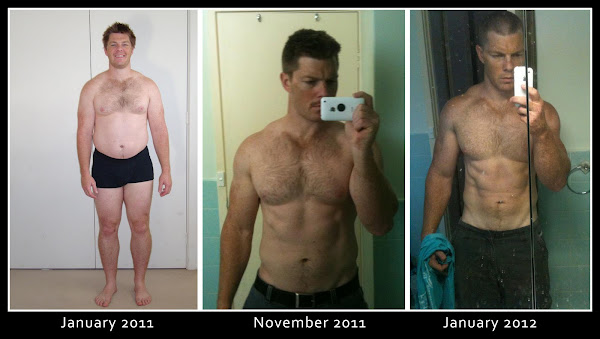
Since then I’ve made incredible progress, I don’t recognise myself. I’ll send you a picture taken in Jan 2011 and another taken a little while ago in November. Transforming my mind has allowed me to transform my body. I’ve never in my life felt as capable of anything I decide to do as I feel today. I seek out things that scare me and I attack them. I feel things deeper than I ever have and my mind is always searching for that next morsel that might just change the way I view the world. Julian, I feel lucky to have found your blog, to have learned who Robb Wolf is and to have been exposed to Mark Sisson’s work. I feel enormously enlightened and humbled by the works of Sam Harris, Christopher Hitchens and Richard Dawkins. The internet is fucking amazing, I guess I just feel lucky.
And I need your help. I need this story broadcast, I need everyone I know and everyone I don’t to read this. I need that for me but mostly I just need to tell my wife that I love her and that I’m sorry, and that anything she chooses to do for her happiness is the right decision. I need her to know that she should never settle for happier than she’s been in 10 years when what she deserves is happier than she ever imagined you could be.
So what I’m asking is that you post this on your blog, send it to anyone you can, comment on it or don’t. I just need it out there…
Thank you,
Clyde Rathbone”
I hope Clyde's story encourages others to face the problems associated with mental illness.


The information contained in this blog can not be considered medical advice. These are only my own thoughts, feelings & ideas. If you or someone you know are having problems with mental illness please seek qualified medical advice.